4 posts tagged with "automation"

View All Tags

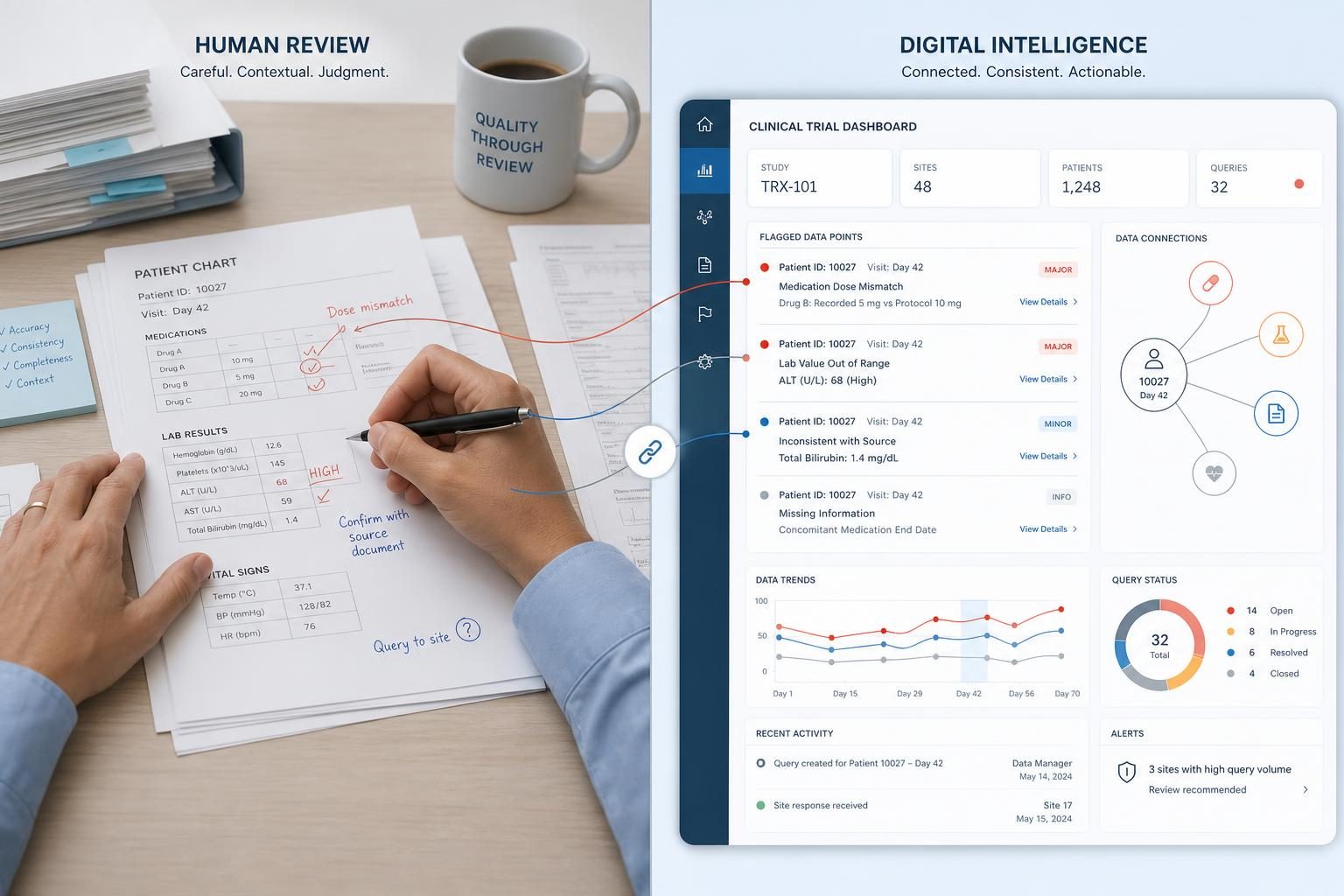
Automated Source Review vs. Manual Clinical Trial Quality Checks

9 min read

Clinical operations teams face a stubborn tradeoff: they need enough source review coverage to detect meaningful discrepancies, yet manual review can produce uneven coverage and repetitive work. A reviewer may spend hours comparing dates, laboratory values, medication records, and visit notes while still missing a pattern spread across several sites. A well-designed clinical trial source data review process combines automated checks for repeatable signals with qualified human judgment for records that require context.

Quick answer: Use automation to scan accessible, structured source information for defined discrepancies, then route exceptions to trained clinical and quality staff. Keep manual review for narrative documentation, safety decisions, eligibility questions, protocol deviations, specialized assessments, and any finding that requires interpretation. The right comparison is task allocation, not technology versus people.


Read more →

Clinical Trial Pre-Screening FAQ: Questions Coordinators Ask

4 min read

Can clinical trial pre-screening automation reduce repetitive eligibility checks without taking decisions away from coordinators? Yes. It can organize candidate information, compare explicit protocol criteria, identify missing evidence, and route uncertain records for human review before a formal screening visit.

The safest setup treats automation as decision support. A traceable review queue is more useful than a bare eligible or ineligible label, especially when records conflict or a protocol changes.

Read more →

7 Clinical Trial Source Issues Automated Review Can Catch

5 min read

Manual source review can miss a contradiction hiding across a visit note, laboratory report, and EDC entry. The volume makes the problem worse: reviewers may inspect each document carefully yet fail to connect related records. Automated clinical trial source issue detection can scan repeatable patterns and place potential problems in a review queue.

Quick answer: The highest-value checks cover missing fields, conflicting records, unusual measurements, broken timelines, copied text, unexplained edits, and source-to-EDC mismatches. Automation identifies signals; qualified clinical, data, and quality staff decide whether each signal represents a real finding.

Read more →

The Complete Guide to Clinical Trial Operations Automation

13 min read

Clinical teams often know a study is slipping before the dashboard catches up. A site has submitted most of its activation documents, but one training record sits in an inbox. An amendment reached some countries, while other sites still use the previous schedule. Finance has an invoice, yet nobody can quickly confirm which contract version supports it.

Quick answer: clinical trial operations automation works best when it moves bounded, repeatable tasks through defined rules, qualified human review, exception handling, and a retained record. Start with work that has clear inputs and outputs. Keep medical, regulatory, investigator, and other judgment-heavy decisions with authorized people.

Read more →